
 Deutsch
 English
 Čeština
Allotoca-Mesa Central, annual report 2025
Submitted by daniel.elster on 8. April 2026 - 14:48
Allotoca-Mesa Central, annual report 2025
Membership figures in 2025
Membership numbers did not change significantly in 2025 compared to 2024. At the end of the year, 45 participants from 15 countries were registered. However, it is important to remain realistic in this context, as not all participants keep fish and some of the registered persons do not comply with their reporting obligations, which means that the number of participants will probably have to be corrected in the course of 2026. In addition, there are participants who have lost their fish and therefore want to withdraw from the project completely. This is unfortunate, but unfortunately cannot be changed. The focus of fishkeeping has also shifted completely to Europe.
Current situation of Allotoca stocks in aquariums
This year, the census started a little later, but some members had already reported their stocks in October on their own initiative. Many thanks for this, as it makes the work much easier when the report is submitted without being requested.
The general tenor of many responses was that 2025 was not an outstanding year for the breeding project. In some cases, there were total losses, which then led to abandonment or relatively poor breeding figures. This was partly due to the fact that it is not easy to distribute these fish. However, it is important to follow up every year. This should not be done on a large scale, but in such a way that there is sufficient rejuvenation in the group. This is certainly a topic for a longer discussion.
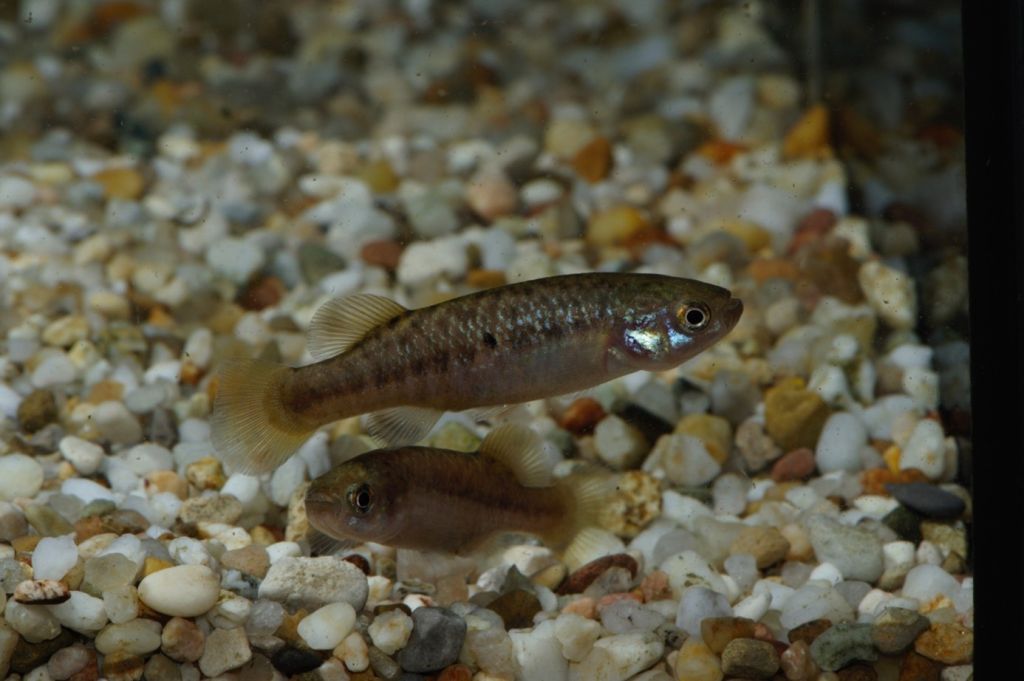
Allotoca goslinei pair Foto: Michael Köck
Here are the results as at 31.12.2025:
BAP subproject
Allotoca catarinae:
In 2025, the number of keepers represented in the project increased from 8 to 11, but this was accompanied by stagnating stocks of 141 registered fish. Here, too, there were significant losses among previously successful keepers. The hope is that they will be able to stabilise their stocks again and that we may be able to reach a stock of 400 animals with additional new keepers.
Allotoca diazi:
The population of Allotoca diazi increased slightly again in 2025. We now have 339 animals in the project, kept by 11 owners. However, Chester Zoo alone accounts for approximately 50% of the population.
This is certainly reassuring for the project, but in the interests of a stable population, we should make further efforts in the hobbyist sector.
Allotoca meeki:
There were some changes in the number of participants in this species, but the new additions almost offset the departures, so the current number of keepers can be considered constant, rising from 17 to 18. However, two keepers have not yet submitted their stock reports, which means that the result is certainly not entirely accurate. The population thus fell to 395 reported animals, which represents a loss of almost 50% compared to 2024, the previous record year.
Due to the threat to this species in the wild, it would be particularly desirable for participants to keep larger populations in their aquariums. Even if this leads to discussions about a significant surplus of offspring. However, in order to keep the fish healthy and manage the population, regular breeding in sufficiently large tanks should form the basis for keeping this species.
Allotoca zacapuensis:
This species suffered some of the greatest losses. On the one hand, the number of keepers has fallen from 16 to 9, with 4 keepers not reporting. In three of these cases, we must probably assume that the keepers have given up. Unfortunately, it is not possible to contact them at present.
For the reasons mentioned above, the population has almost halved from 693 animals to 374 animals. Unfortunately, this is not good news, and the remaining keepers should keep a close eye on their stocks.
LANP sub-project
Allotoca dugesii:
In the case of Allotoca dugesii, the situation remained stable at least until 2025.
We have 7 keepers with 70 fish in the Altdu1-COR-Sant population and 8 keepers with 151 fish in the Altdu4-PAT-RMol population. However, the latter population has also declined significantly. Unfortunately, this has negated the successes of 2024.
Allotoca goslinei:
Unfortunately, the success story for Allotoca goslinei could not continue in 2025.
The population collapsed by almost 60%, leaving only 170 animals remaining (2024: 426 animals). Twelve keepers still have fish in their stocks, although some only have a very small number of fish left. We can only call for greater commitment here, as these fish are already extinct in the wild and our stocks are therefore of great importance.
Efforts are also being made in Mexico to return these fish to their natural habitat. These efforts are strongly supported by Munich's Hellabrunn Zoo, which is now also part of our species conservation programme. In 2025, animals from France, the Netherlands and Germany were brought to the zoo to ensure a sufficiently large starting population from different sources.
There is therefore hope that this institutional keeper will improve the situation in the population somewhat.
Allotoca maculata:
Here, the number of holdings decreased from 9 to 7 in 2025, and the population fell significantly from 196 to 113 animals. One keeper had not reported.
For years, we have been trying to keep this population stable in the project, but this is obviously a problem for some keepers.
Neoophorus regalis:
We are in a somewhat difficult situation here. To our knowledge, two project members currently have fish of this species. The population remains very small, numbering 22 animals.
A little more communication with the responsible project manager would have been desirable here, but now we hope for successful breeding for other potential keepers.
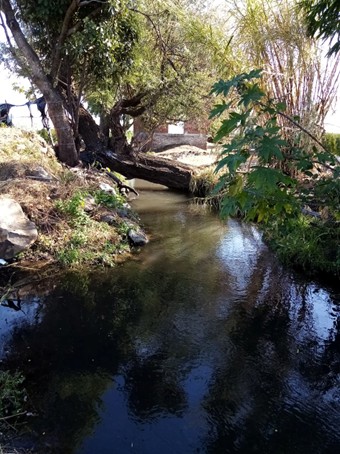
Stream near Los Reyes with Neoophorus regalis Foto: Michael Köck
Summary and prospects for 2026
In this reporting year, it is difficult for us to look ahead to 2026 with optimism.
One of the main goals must be to increase stocks overall, but also among individual keepers. To this end, it is certainly helpful to keep your population in a larger species tank and to seek contact with the project managers on your own initiative if your own stock is causing problems. However, it is also important to point out the procurement channels. Anyone who needs fish should register their interest at an early stage and also be able to transport these animals over long distances or organise this transport. The annual meetings of the Goodeidworkinggroup are also a good opportunity to exchange animals. As species managers, we can help with the mediation, but a little initiative on your part is unavoidable. One example of this is the procurement of Allotoca goslinei for Munich's Hellabrunn Zoo. It took almost a year from the initial enquiry to the final handover.
For 2026, there is a request from Mexico for Allotoca goslinei and Allotoca dugesii (Altdu1-COR-Sant) in order to create a starting population for the planned reintroduction into the wild.
However, given the low population numbers in the project, it is not easy for us to give away animals. We are trying to find a solution, with your help, of course. But to do so, we often need time and stocks that are large enough.
The species most threatened in the wild at the moment are Allotoca goslinei, Allotoca meeki, Allotoca maculata and the Rio Santiago population of Allotoca dugesii.
Therefore, we ask you to keep your stocks in larger aquariums and in higher numbers per population, if possible. Continuously breed fish, not necessarily in large numbers, but enough to keep your stock stable. Always have several generations in the population and make sure that your population cannot collapse if you ever have to give away animals. Do not give up immediately if you lose animals to disease. It is not pleasant, but unfortunately it happens, and please report any problems early on.
Many thanks for your active co-operation.
Category: